Stellar - dashboard
Unifying Asset Management at Spectral.
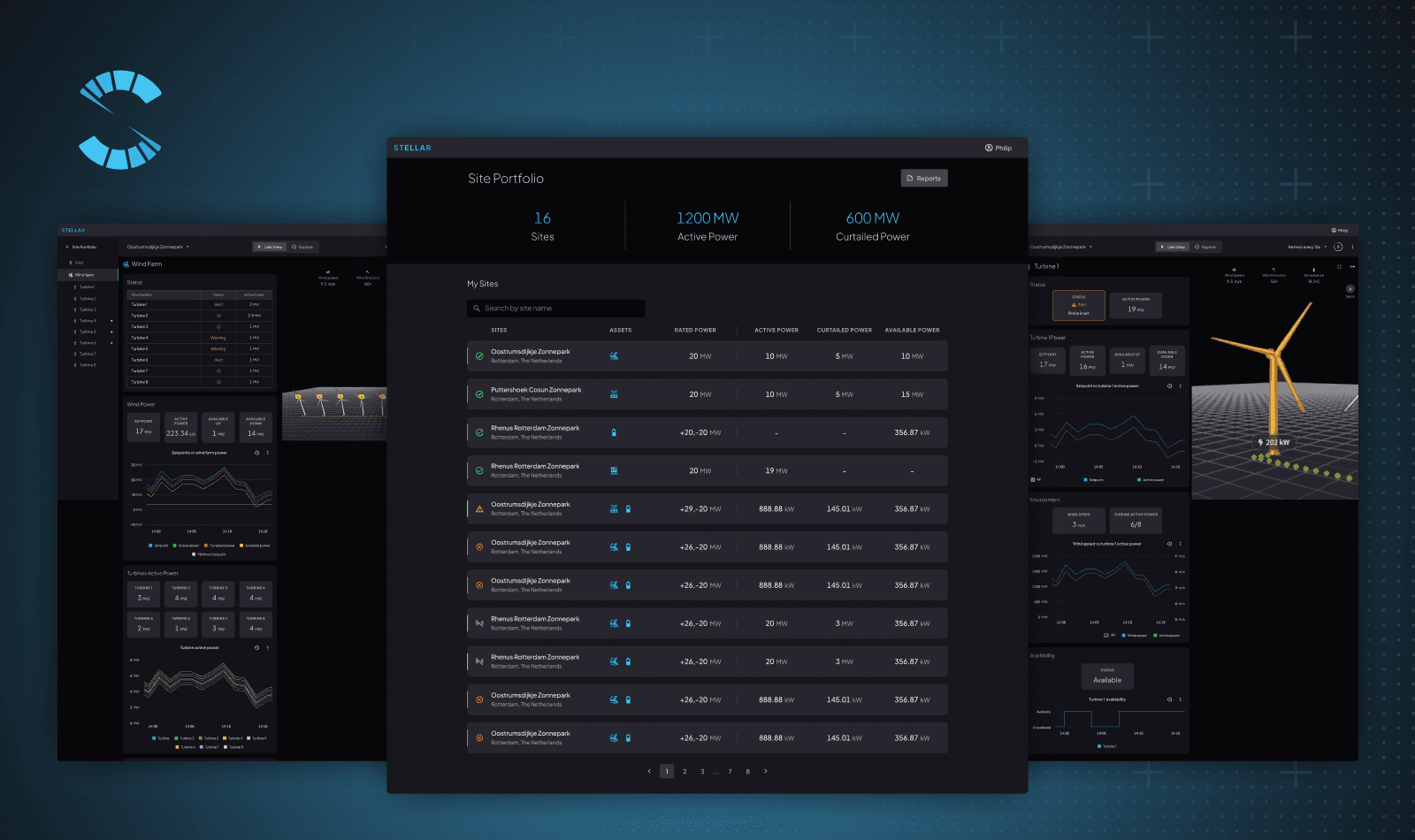
A legacy product and Grafana dashboards. STELLAR replaced both with one unified platform which built the design foundation that helped Spectral scale and secure investment from ABN AMRO.
Industry :
Energy tech
Role :
Product Design
Platform :
Web
Company :
Spectral
Context :
Spectral Energy builds software to manage renewable energy assets. Wind farms, solar parks, battery systems. When I started at Spectral, clients weren't managing their own assets. They relied on Spectral's control engineers to do it for them.
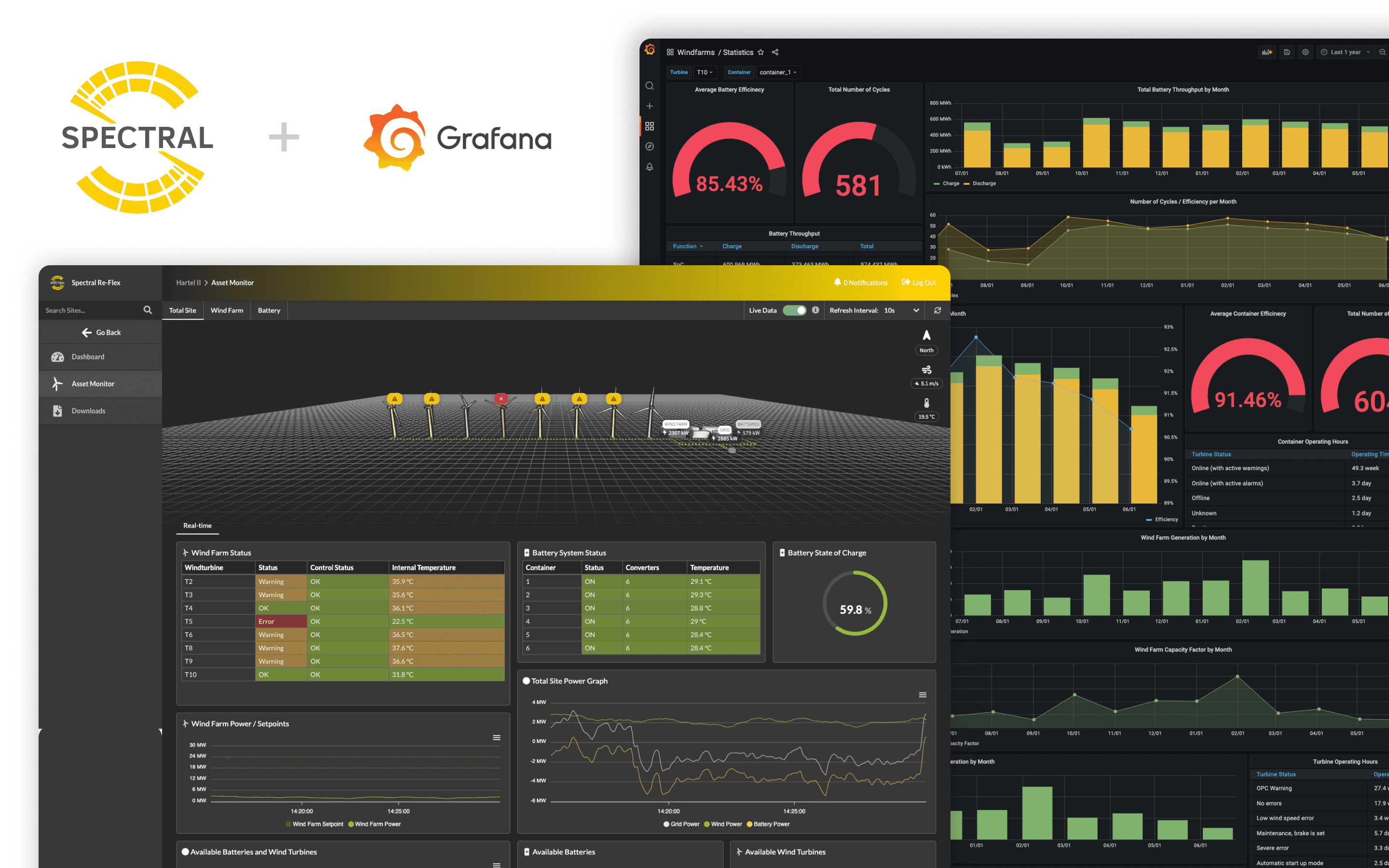
Two tools existed. Re-flex, the legacy platform. And a Grafana dashboard that engineers had adopted as a workaround because Re-flex couldn't give them the data they needed. Two disconnected tools. No shared foundation. No path to self-service.
There were also two types of users with completely different needs. Asset managers, who operate assets day to day and need real-time data and control. And asset owners, investors and fund managers who just need status and reports. The platforms treated them as one user.
Challenges :
Challenge 1
The platform couldn't support self-service. Spectral's goal was to move clients off a service model onto a product they could use independently.
The existing tools had grown by accumulation. Every client request bolted on as a feature. No structure. No hierarchy. Just bloat.

Challenge 2
One platform, two users with opposite needs. Asset managers need real-time data, visualizations, and control.
Asset owners need status updates and reports. Treating them as one user meant the experience worked poorly for both.
Challenge 3
Control engineers were the human middleware. Every request from both user types ended up with the control engineers. Support tickets, calls to client managers. They were doing the work the platform should do. That was the real bottleneck.
Solution :
Solution 1
The split: Live View and Explore.
The core structural decision.
Asset managers get "Live View": Real-time monitoring, asset hierarchy and control.
Asset owners get "Explore": Historical data, deep dive into asset performance.
One platform. Two lenses on the same data. This one decision removed an entire category of support requests.
Solution 2
Rebuilt navigation and information architecture.
I stripped the navigation back, removed the feature accumulation and rebuilt the IA around how users actually think about their assets, not how engineering had categorized features. Contextual asset data surfaced where users needed it, without raising a ticket.
Outcome :
Replaced Re-flex and Grafana with one unified platform. Asset managers and owners could access what they needed without contacting Spectral. Self-service achieved.
Clickable Prototype
Impact :
50% reduction in support tickets. ABN AMRO invested to expand STELLAR. The design foundation is still what the team builds on today.

